Key Takeaways:
- Keyword research services are crucial for crafting content that resonates with audience interests and search behaviors.
- Effective keyword research involves understanding search intent, utilizing advanced tools, and analyzing competitors.
- Integrating keyword insights into content strategy enhances visibility, engagement, and overall marketing success.
Understanding the Role of Keyword Research in Content Creation
Building content that truly resonates with your audience starts with thorough keyword research. By identifying the specific terms, phrases, and questions your target audience enters into search engines, you can tailor your topics, language, and structure to effectively meet their needs. Data-driven keyword insights not only enhance your search engine visibility but also guide the creation of content that is practical, relevant, and timely. Utilizing professional keyword research services, such as those offered at https://victorious.com/services/seo/keyword-research/, helps uncover high-value keywords that might otherwise be overlooked, unlocking greater potential in your overall content strategy.
Understanding and interpreting the signals from keyword research ensures that your content calendar aligns with what your audience actually wants to read. This process is deeper than just spotting high-volume keywords—it’s about mapping searcher intent, seasonal trends, and gaps in available content. By doing so, you consistently deliver value and attract engaged organic traffic.
Utilizing Advanced Tools for Comprehensive Keyword Analysis
Comprehensive keyword analysis requires powerful, data-driven tools. Platforms like Google’s Keyword Planner, Ahrefs, or SEMrush allow marketers to analyze search volumes, keyword difficulty, and SERP competition. Beyond the basics, platforms like BrightEdge’s Data Cube provide granular insights into billions of keyword data points, surfacing hidden trends and valuable keyword opportunities. Machine-driven analysis enables content marketers to identify which search terms are gaining or losing popularity, facilitating agile adjustments to their content strategies.
Effective use of these tools means filtering through noisy data to surface keywords that aren’t just popular but relevant to your target personas. Discovering contextually related keywords, search questions, and long-tail topics gives you a competitive edge, allowing you to rank for specific queries that drive qualified traffic to your site.
Analyzing Competitor Keywords for Strategic Advantage
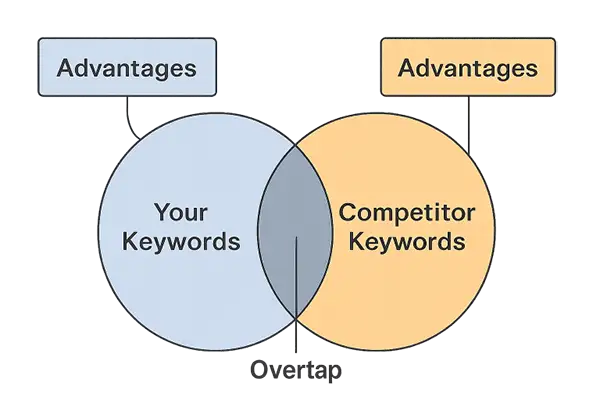
Competitor keyword analysis is a crucial step in outperforming your competitors in your industry. Reviewing the keywords your competitors target can highlight content gaps you can fill and niches where your expertise or unique viewpoint stands out. Tools like SEMrush and Ahrefs enable you to quickly extract competitor keyword profiles and backlink data, allowing you to reverse-engineer the top-performing strategies of others.
By auditing competitor websites and content, you can identify patterns in their successful posts, such as the questions they answer most frequently or the keyword clusters that drive the most traffic. Adopting this data-driven, competitive approach enables you to create differentiated content that can win over new audience segments and improve your site’s performance, an approach widely recognized by marketing leaders such as HubSpot.
Integrating Keyword Insights into Content Strategy
Once you’ve built a robust list of target keywords, it’s essential to integrate those insights throughout your content strategy. This step is more than stuffing text with repeated keyword phrases; it’s about understanding how, where, and why those topics fit the needs of your audience. Segment keywords into clusters that can guide the creation of pillar pages, supporting articles, and topical hubs.
Incorporating long-tail and semantically related phrases ensures your site ranks for a wide range of user queries, driving both high-volume and highly targeted traffic. It’s also important to use keyword intent data to shape your content structure—answering transactional, informational, and navigational queries across your site.
Monitoring and Adapting to Keyword Performance
Continuous monitoring is a core component of any sustainable content strategy. Keyword trends, competitive landscapes, and audience interests naturally shift over time, meaning older content might lose its relevance or ranking power. Routinely reviewing analytics and search performance metrics enables you to identify content that needs refreshing or opportunities that were previously overlooked. By adopting a proactive approach, content creators can keep their articles current and retain top search positions.
Regular keyword performance reviews can also uncover seasonal opportunities, especially when monitoring metrics via GA4 or Google Search Console. Reacting to such data ensures your strategy evolves alongside your industry.
Leveraging Natural Language Processing for Enhanced Keyword Research
Natural Language Processing (NLP) has transformed how marketers approach keyword research and content optimization. NLP-driven tools analyze vast quantities of text to extract core themes, related topics, and contextual keyword clusters. By leveraging modern NLP capabilities, marketers can identify hidden synonym patterns and variations in user language that may not be apparent through traditional keyword research.
This extension of keyword research means your content is better aligned with how people actually search and speak, maximizing opportunities for semantic search visibility and featured snippet placements. For more information on the impact of NLP on modern marketing, refer to resources from established publications such as Search Engine Land.
Applying Machine Learning Algorithms for Keyword Prediction
Machine learning algorithms are redefining the speed and accuracy of keyword predictions. Drawing on historical keywords, search volume trends, and evolving topical relationships, advanced models can forecast emerging content opportunities before they become saturated. Marketers who harness machine learning for keyword research benefit from data-driven decision-making, positioning their content ahead of evolving trends and search behaviors.
This predictive capability enables you to craft content strategies that proactively address audience needs, thereby elevating your visibility in competitive search environments.
Conclusion
Keyword research services provide the essential groundwork for building a content strategy that is both measurable and effective. Through intent-based analysis, marketers can understand what users truly want, allowing them to craft highly targeted topics and messaging. Advanced SEO tools help identify valuable search terms, while competitor data reveals opportunities to outrank others in the same space. Incorporating NLP techniques refines content to match natural language patterns, and machine learning predictions guide future trends. Together, these elements enable the creation of content that performs well and genuinely connects with audiences. Ongoing evaluation and adjustments keep your strategy aligned with evolving search behaviors and industry changes.