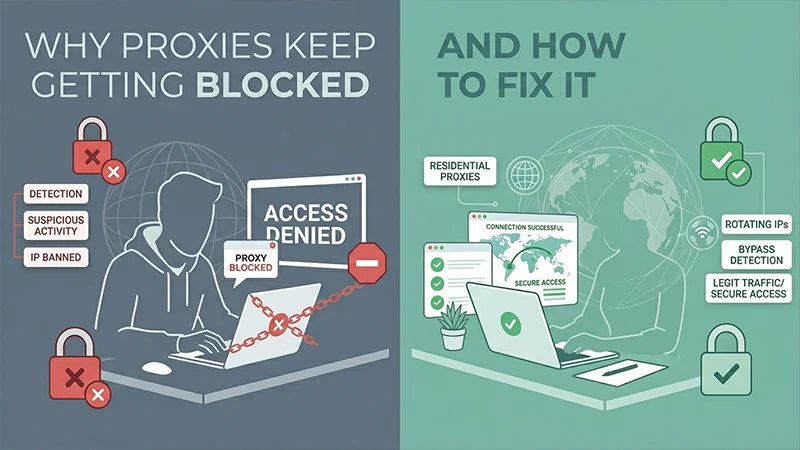
You invested in ISP proxies for their speed and legitimacy. So why do target sites keep shutting you out? The answer lies in patterns you might not even know you’re creating.
ISP proxies sit at the premium end of the proxy market for good reason. Unlike datacenter proxies, they are assigned by real Internet Service Providers to real residential addresses giving them an authentic digital footprint that most anti-bot systems are supposed to trust. Yet time and again, users report the same frustrating problem: blocks, CAPTCHAs, and 403 errors that weren’t supposed to happen.
If this sounds familiar, you are not alone. Understanding why these blocks occur and more importantly, how to stop them, can be the difference between a proxy investment that pays off and one that bleeds budget without results.
What Makes ISP Proxies Different?
ISP proxies, sometimes called static residential proxies, carry IP addresses registered under major ISPs such as Cox Communications, British Telecommunications, or Rogers Communications. To a website’s lookup tools, the IP appears to belong to a household instead of appearing as a server. This gives them a significant trust advantage over datacenter IPs.
The problem is that this advantage is conditional. Websites and their anti-bot vendors such as Cloudflare, Akamai, DataDome, PerimeterX, have grown considerably more sophisticated. They no longer rely solely on IP reputation. They analyse behaviour, timing, fingerprints, and traffic patterns. An ISP Proxy that acts like a bot gets treated like a bot, regardless of its origin. For example, a legitimate ISP address sending 400 requests per minute is still suspicious because no real human browses that fast.
The Seven Most Common Reasons Your ISP Proxies Get Blocked
1. Request Velocity That Exceeds Human Norms
The most widespread cause of ISP proxy blocks is simply sending too many requests too quickly. Even the cleanest ISP IP will raise red flags when it hammers a server at machine speed. Real users have natural pause patterns: they read, click, scroll, and think. When your scraper or automation skips all of that, velocity analysis catches it fast.
2. Shared IP Addresses That Are Already Flagged
Not all ISP proxy pools are equal in hygiene. Some proxy providers offer IPs that have been sold to dozens of other clients or reused extensively. If a previous user burned an IP through aggressive scraping or policy violations, that address may already be on block lists or carry a low trust score before you even send a single request. When choosing a provider, always verify how frequently the IP pool is rotated and audited. High-quality ISP proxy services maintain strict usage policies and replace flagged addresses proactively.
3. Mismatched Browser Fingerprints
Modern bot detection goes well beyond IP checks. Sites analyse your TLS fingerprint, HTTP/2 settings, header order, and JavaScript environment. If your ISP proxy is paired with a bare HTTP client instead of a real browser profile, the fingerprint mismatch instantly signals automation regardless of the IP itself being spotless.
4. Lack of Session Consistency
Rotating your proxy on every single request can backfire. Many sites track sessions via cookies, behavioural patterns, and login states. Suddenly changing IP mid-session is a strong anomaly signal. Unless the target site requires it, stick with the same ISP IP for the duration of a logical user session.
5. Targeting High-Security Endpoints Directly
Jumping straight to a protected API endpoint or product page without simulating a realistic entry path (homepage, search, category page), is a textbook bot behaviour pattern. Human users almost never navigate this way. Anti-bot systems model normal user journeys and flag traffic that skips them.
6. Operating at Predictable, Regular Intervals
Cron-job-style automation that fires at perfectly regular intervals (every 60 seconds, on the minute, every hour exactly) is surprisingly easy to detect statistically. Real traffic is noisy and irregular. Mechanical regularity is a signal no amount of IP quality can override.
7. IPs on Datacenter ASNs Masked As ISP IPs
If your proxy provider, for your ISP proxies order, is offering you IPs hosted on ASNs such as Cogent, NTT or GTT, these ASNs are simply commercial ASNs which do not have real residential users on these ASNs. Platforms simply treat IPs hosted on these ASNs as non-legitimate users. Even if you don’t get blocked, you are very likely to face issues in the long-run.
Quick Diagnostic Tip
If you are being blocked on the first request, before any session is established, the problem is almost certainly IP reputation or ASN-level blocking. If blocks happen after several successful requests, behavioural detection is the more likely culprit.
How to Fix It: A Practical Framework
Solving ISP proxy blocks is rarely about finding a silver-bullet tool. It requires a layered approach that addresses IP quality, request behaviour, and technical fingerprinting together.
- Audit your IP pool quality first: Before changing anything else, verify the reputation of your current IPs using online fraud score lookup tools like Scamalytics. If a significant share of your pool is flagged, asking for a fresh pool or switching providers may solve 80% of your problems immediately.
- Implement randomised delays between requests: Replace fixed wait times with randomised intervals that mimic human reading and interaction speeds. A range of 2 to 8 seconds between page-level requests, with occasional longer pauses, dramatically reduces velocity-based detection.
- Pair proxies with realistic browser profiles: Use headless browsers like Playwright or Puppeteer with stealth plugins, or invest in browser automation platforms that spoof TLS fingerprints and JavaScript environments accurately. Your ISP IP quality means nothing if your client broadcasts “I am a bot” at the TLS layer.
- Build session-aware rotation logic: Design your rotation strategy around logical user sessions, not individual requests. Assign a single ISP Proxy to an entire session that is, login to checkout, or search to result click.
- Simulate realistic navigation paths: Begin sessions from organic-looking entry points: a search engine referral, the homepage, or a category page. Mimic the kind of journey a real user takes before reaching your target resource.
- Add natural noise to your scheduling: If you are running recurring jobs, introduce jitter into your timing. Instead of running at exactly 09:00 every hour, vary start times by 5 to 15 minutes either early or delayed. Statistical irregularity is a trust signal.
Choosing the Right ISP Proxy Provider
Even perfect behaviour cannot compensate for a fundamentally low-quality IP pool. When evaluating providers, look beyond the marketing and ask specific questions:
- How frequently is the IP pool audited and replaced?
- Are IPs truly static and exclusive, or shared across multiple customers?
- Which ISPs are used and are they Tier-1 carriers or smaller regional providers?
- What geographic coverage is available and is targeting granular enough for your use case?
The difference between a provider that answers these questions confidently and one that deflects them often correlates directly with real-world performance. Spending slightly more on a transparent, well-maintained ISP proxy provider typically costs far less in the long run than constantly troubleshooting a cheap but unreliable pool.
An example of a trusted ISP proxy provider is ProxySwag. They only offer ISP proxies but they have specialised in it. While offering them across 4 countries and having a massive ISP IP pool, they’re sufficient for most power users.
Conclusion
ISP proxies remain one of the most powerful tools in any data professional’s stack but they are not magic. Blocks happen when behaviour, fingerprinting, and IP quality fail to align with what a real user looks like to increasingly sophisticated detection systems. The good news is that every one of the causes outlined above is fixable with deliberate configuration.
Audit your IPs, slow down your requests, simulate human behaviour, and choose your provider carefully. When these elements work together, ISP proxies deliver exactly what they promise: reliable, trusted access that gets results without the constant friction of detection and blocking.