The UAE hotel industry is well known for its exceptional service, luxury accommodation, and international visitors. From beachfront resorts to Dubai to Abu Dhabi business hotels, properties should provide comfortable and personalized experiences. As guests’ expectations evolve, hotels are exploring smarter ways of managing communication, simplifying daily operations, and improving service quality while maintaining consistency.
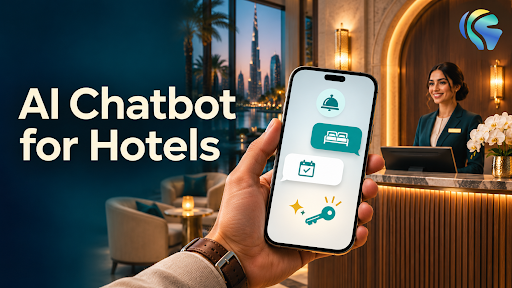
AI chatbot for hotels assists the hotel enterprises in responding to requests, helping booking, and satisfying the regular demand of the customers without requiring the continued participation of staff. These intelligent assistants can communicate with travellers during different stages of their stay to ensure that useful information is provided and hotel staff can concentrate on more complex responsibilities.
Digital communications have become a key part of hospitality management for UAE hotels that serve guests from different countries and time zones. Travelers appreciate ever more quick responses, convenient booking support, and accessible support. Hotels will have the opportunity to enhance efficiency by introducing conversational technology to their operation and, at the same time, providing the personal attention they enjoy for an unforgettable guest experience.
Why UAE Hotels Are Adopting AI Chatbots
The UAE Hospitality Market serves a varied mix of international tourists, business travelers, families, and luxury travelers. Each group has different expectations about reservations, communications, and hotel facilities.
Manually managing these requirements could be difficult, particularly during busy travel times, large exhibitions, and international events.
A hospitality chatbot helps hotels manage recurring communication tasks and keep the information accessible all day long.
For example, a traveler who plans a vacation to Dubai can ask about transportation at the airport, breakfast, or family-friendly conditions. Rather than waiting for an email, the guest can get relevant information through automated conversation.
This technology can also assist maintain consistent in communicating features during peak occupancy times when reception teams handle different responsibilities.
For hotels which have Dubai, Abu Dhabi, Sharjah and other Emirates, intelligent guest communications offers a potential to improve the service accessibility without continuously increasing the administrative workload.
How AI Chatbots Improve Hotel Reservations and Booking Management
Reservations are one of the most important interactions that a hotel and its potential guests have. Travelers often compare accommodation options before deciding where they stay.
A hotel reservation chatbot can simplify the process by answering booking-related questions and directing visitors to the correct accommodation options.
When connected to a hotel reservation system, it may help guests check the availability of rooms, understand booking conditions, and examine different kinds of rooms.
Consider a family planning a vacation in Dubai, and they might like connecting rooms, breakfast packages, and airport transportation. Instead of talking to several departments, they could discuss their requirements within one conversation.
The chatbot can provide relevant information and lead to the next booking step.
Such an approach may also encourage direct hotel booking on websites by reducing unnecessary delays in communication.
Reservation help, however, works best when the chatbot can access accurate availability, prices, and booking information. Hotels should prioritise reliable integrations instead of fully relying on predetermined responses.
The Role of AI Concierge Services in Modern Hospitality
Traditional caretaker services have always been important in premium hospitality. Guests rely on hotel teams to assist them with restaurant reservations, transport arrangements, local sights, and personalized assistance.
A hotel AI concierge adds a few of these services to digital communication channels.
Guests can ask for nearby attractions, available facilities, dining, or hotel policies without visiting the reception area.
A person who lives in a resort in Abu Dhabi can request information about a spa or a meal experience, for example. A connected digital assistant may explain options and help you start a corresponding service request.
The technology can also help support common requirements for stays, including household examinations, supplemental amenities, and general information about real estate.
The main point is that the digital concierge is not designed to deny people hospitality.
Instead, staff helps to help people save time to answer frequently asked questions and spend more time providing support to guests who need personal attention, special arrangements or rapid assistance.
This combination of automation and human service can make it easier for guests.
How Conversational AI Supports Multilingual Guest Communication
Language accessibility is particularly important in UAE hotels, since guests come from several international markets.
While one visitor can feel more comfortable communicating in Arabic or another supported language, a European traveler may prefer English.
Conversational AI in hospitality enables hotels to provide more flexible communication by interpreting and answering natural language questions.
Modern conversational assistants may understand various ways to ask similar questions, in contrast to conventional scripting systems.
For example, guests might ask if they can eat a little early before they go to the airport when breakfast starts.
A well-configured assistant can recognize the underlying request and provide information that is based on the current policy on the property.
Hotels should also continue to verify language accuracy, in particular in the context of exchanging information on booking conditions, cancellation policy, and important service information.
Careful implementation allows international travellers to feel comfortable by providing multilingual assistance, as well as improving access to hotel information.
How AWX Helps UAE Hotels Deliver Smarter Guest Experiences
Choosing the right technology is crucial for hotels that want to enhance guests’ communication without complicating any activities they have to undertake.
AWX provides a smart hospitality solution to connect guest discussions with hotel information and operational workflows.
Instead of working as a basic Q & A tool, AWX supports communication via channels such as website chat, WhatsApp, email, and SMS.
The approach aims to connect conversations with relevant hotel systems such as real estate management platforms, booking machines, and guest-service processes.
This offers more contextual assistance by hotels, which is related to reservation requests, routine requests, and outreach to guests.
For example, when a visitor requests changes to the reservation, a properly integrated system may have access to relevant booking information and support the correct workflow.
AWX has also supported the transfer of persons when a request requires an assessment of the staff to enable individuals to understand their conversations by not asking their guests to repeat everything.
Looking for more connected operations, the AWX AI chatbot offers you a handy way to combine automated assistance and personal services for guest customers for hotels in the UAE.
AWX’s objective is to help hospitality teams generate more responsive experiences through the combination of digital conversations with everyday hotel activities while reducing the need to do repetitive administrative work.
What UAE Hotels Should Consider Before Implementing a Chatbot
A hotel chatbot implementation requires more than adding a message window to a website. Hotels should first understand which guest interactions use most of the employees’ time.
Common starting points include reservations, check-in policies, information about the facilities, and frequently requested services.
Integration is another important consideration. A chatbot that is linked to precise hotel systems can offer more helpful help than one that relies on outdated information.
Hotels should also estimate multilingual support, data protection needs, escalation processes, and compatibility with existing channels of communication.
The team can evaluate the performance before adding automation, which is based on a limited number of guest-service tasks.
Regular reviews of the feedback of guests, accuracy of answers and successful implementation will allow hotels to determine if technology makes important timely improvements available.
Frequently Asked Questions
What is an AI chatbot hotel?
It is a smart digital assistant that helps hotels answer questions from visitors, maintain reservations, and automatically manage routine communications.
Can hotel chatbots help to boost direct reservations?
Yes. They may answer questions about booking when they are connected to booking systems, and help potential guests book directly on hotel channels.
Can AI chatbots accommodate a small UAE hotel?
Yes. Boutique hotels and smaller homes can use chatbots to handle general questions and to provide support outside regular staff hours.
Could hospitality chatbots speak in Arabic?
Certain platforms have Arabic and other languages. Hotels must confirm linguistic capabilities and test the accuracy of the response before their implementation.
Are AI chatbots going to replace the staff at the hotel reception?
No. They are most useful in addressing repeated requests, while staff deal with complex situations and individualised communication with guests.
Conclusion
AI-powered guest communication is becoming a more useful part of the modern hospitality industry in the UAE. From making reservations easier to supporting multilingual conversations and routine service calls, smart chatbots can help hotels increase their efficiency without sacrificing the level of attention.
If there are solutions like AWX linking guest communication to the operating workflows, hotels may provide a more user-friendly experience for the traveller, while at the same time allowing their teams to pay particular attention to providing exceptional hospitality.